
Introduction
Many economists (mostly microeconomists) claim that the study of incentives is at the core of the field of economics. They maintain that by studying incentives, we can explain why certain people do (or don’t do) certain things and we can design or manipulate incentives to achieve the desired behaviour of people. This is essentially the economist’s way of thinking and how they view the world.
As someone who has a strong appetite for economics, I often think in the same way too. One problem that seems particularly well addressed by the incentive method is the low quality of teaching at Australian universities. This is a problem that many people do not realise because teaching quality is difficult to measure quantitatively. But when I think back to my experience at Monash University and the University of Melbourne, something was clearly not right. The stories I hear from friends from other universities do not paint a nice picture either. The trouble about university lecturers is that they know a great deal about their fields of study, but they are unable to effectively transfer or communicate their knowledge to students.
There are basically two kinds of incompetent lecturers: one that simply lacks the skill to explain something clearly, and one who thinks everything is so easy there is no need to explain. But the prevalence of this problem among universities suggests there is a deeper problem. Lecturers do not seem to care about teaching because they do not get any pressure from faculties and universities. Faculties and universities do not assert pressure because they in turn do not care about teaching; all they care about is research, publication, and citation. Now the important question is, why do they not care about teaching? This paper endeavours to find an answer to this question, then eliminate this root cause, using the incentive approach by examining the motivation behind universities’ action and inaction.
The fundamental question is, what are the motivations that push universities to do what they do? For anyone who went through university and got to know the people in charge, it is not difficult for them to find that universities are motivated by two things: money and reputation. That is, universities want to achieve higher profit, and better reputation and prestige, and everything they do is aimed at these goals.
Money
It will then be natural to examine universities’ revenue streams.
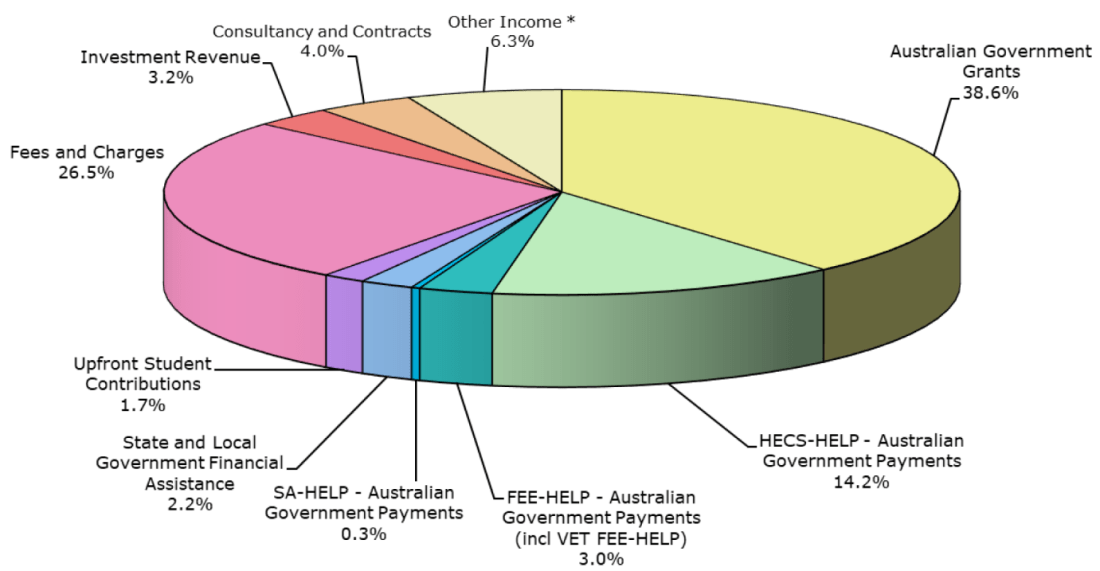
Figure 1 above is a summary of Australian higher education providers’ operating revenue by source in 2016. HECS-HELP, FEE-HELP, SA-HELP, upfront student contributions, and fees and charges (which include Continuing Education, fee-paying overseas students, fee-paying non-overseas postgraduate students, fee-paying non-overseas undergraduate students, fee-paying non-overseas non-award students, other domestic course fee and charges, student services and amenities fees, and other fees and charges) are all counted on a per-student basis. Revenues like HECS-HELP do come from the government, but they only come if the university has students, and they increase as the number of eligible students increases. In essence, 45.7% of universities’ revenue come from students. The more students they get, the more money they earn.
So the question is, how to attract more students? But a better question is, what do students look for when choosing a university? Most potential students consider only the reputation and prestige when choosing university. Course design, curriculum, and facilities are relatively irrelevant either because students do not care, or because students have no way of finding out what things are like in universities. They base their decision on the only thing to which they have easy access, namely, reputation through university ranking. The university with the highest rank must be the best university, they figure, and that is the university they pick. We can now see that the incentive of revenue from student enrolment is really the incentive of reputation.
Another revenue stream which has the top share of all revenue is Australian government grants, contributing 38.6%. These grants mostly serve the purpose of funding research, which is another integral part of the universities’ business and paramount to society’s advancement. Combined with the fact that these grants have nothing to do with coursework teaching, we should not try to interfere with this revenue stream and it is best left to the universities to strive for them by showing ever promising research results.
Reputation
We have now seen that the motivation of money eventually leads to the motivation of reputation, so we see two motivations merge into one. We have also pointed out that reputation comes from university rankings, and rankings seem to be the only source of information. In order to accomplish a higher ranking, universities look at the ranking methodologies, and try to do their best at each criterion, fulfilling the requirements given by ranking organisations.
The logical next step is to examine the methodologies employed by ranking agencies. There are three main rankings that are used in Australia: Times Higher Education World University Rankings, QS World University Rankings, and Academic Ranking of World Universities by Shanghai Ranking Consultancy.
QS uses an Academic Survey to ‘collate the expert opinions of over 70,000 individuals in the higher education space’2 in an attempt to assess universities’ teaching quality. This is a bad way of assessing teaching quality in so many ways. There is no consistent, objective standard of teaching. Each respondent’s opinion is just that, opinion, which is highly subjective. Not every university gets the same number of ratings, which leads to the problem of small sample size, or even worse, misrepresentation. Respondents do not appreciate or understand how well classes are taught at the universities they rate because they have not attended these classes! There is no way respondents know exactly how well classes are taught, so they are using reputation to calculate reputation, which defeats the purpose.
Times Higher Education does the same thing: assessing teaching quality by survey. They try to do better than QS by adding metrics such as staff-to-student ratio but these hardly relate directly to teaching quality of individual lecturers.
Shanghai Ranking Consultancy is by far the worst, judging the quality of education with ‘alumni of an institution winning Nobel Prizes and Fields Medals’. This is a poor choice of indicator because the university with the best reputation attracts the best students, so the students they admit are already the best to begin with. This makes it possible to make the argument that the students will succeed even without the university doing anything. This approach also seems narrow-minded when we consider the proportion of Nobel laureates and Fields Medallists within all university graduates. The aim of higher education is just that, to educate people; it is not to produce a select few of distinguished researchers.
In their defence, ranking agencies have a tough job at hand: they cannot physically attend every lecture at every university around the world, therefore it is very difficult for them to measure teaching quality. But that is why this paper exists: to solve a tough problem.
Solution
So far, our logic has been this: the incentive behind universities is reputation, reputation equals university rankings, but university rankings do not properly incorporate teaching quality, hence universities do not have an incentive to improve teaching quality. Now that we know what the root cause is, we need to solve it. In other words, we need to create an incentive for universities to care, and improve teaching quality.
There have been a lot of noises from the Australian government in recent years that they want to reduce funding to universities. It is possible to utilise the incentive approach to study the motives of the government here, but this is out of the scope of this paper. Here we assume the government, particularly the Department of Education and Training, has a genuinely good will and serves to make Australian education, including higher education, better. If this assumption is true, then we can rely on the government to help us play an integral part of the solution, which is better than any funding cut they are currently proposing.
What the government can do, is to pass a regulation that requires all universities to hire teaching assessors. The government can outline a certain number of fields of study, and each university has to hire a teaching assessor for each field of study. Each assessor will go into universities other than their own university, and attend lectures and workshops to closely assess the quality of teaching and classroom delivery in their specified field. A consistent, objective standard of teaching will be established by the government for each field of study across all universities, and assessors will base their assessments on this standard. The assessment results will be sent to three places: the government, universities, and ranking agencies. When the government receives the results, they will be published for the general public to view. Universities will use the results to improve upon themselves. Ranking agencies can incorporate these results into their methodologies, which when combined with the publishing of the results, will in turn create a reputation incentive for universities.
This solution is likely to work because the government does not have to take any financial burden, and the universities are forced by law to take it. But for universities things are not all bad, because they do have a lot to gain by enhancing their teaching. To avoid collusion by universities, the government can hire an independent auditor.
The magic about incentive is that, once it is established and maintained, no more work needs to be done and people will automatically behave as you intended (provided you are smart enough in designing the incentive). Once the reputation of universities involves teaching quality directly, the universities will have an incentive to improve and they can be left by themselves to find ways to advance their teaching. They will automatically become imaginative and innovative in ensuring the best teaching. You may see them require lecturers to attend teaching classes to learn how to teach, with refresher course every two years. You may see them base promotion decision on the teaching assessments. The possibilities are endless from here.
It is prudent to outline some ‘solutions’ which appear easier to implement but will in fact cause more trouble. One such ‘solution’ which many universities are already employing is for students to rate their lecturers at the end of a semester. This is dangerous since it creates an incentive for lecturers to reduce the difficulty of the course and exam in order to please students. Moreover, consistent criteria of good teaching are lacking across different universities in this approach, hence it is not effective in being involved in any ranking methodology, hence no real incentive is created.
Final Words
Incentive is a powerful tool. When used incorrectly, unintended consequences may result and history contains countless cautionary tales. But when designed and administered properly, the benefits can be enormous. In this case, given the value of education to society, we have a chance to achieve long-lasting prosperity for generations to come.
Reference
- Department of Education and Training. (2018). Financial Reports of Higher Education Providers. Retrieved from https://docs.education.gov.au/system/files/doc/other/finance_2016.pdf
- QS World University Rankings Methodology. (2018, January). Retrieved from https://www.topuniversities.com/qs-world-university-rankings/methodology


