
Introduction
This paper endeavours to propose methods to minimise the number and severity of alcohol-related incident and assault in Australia. It must first be understood the seriousness of alcohol-related violence in Australia and the notorious difficulty in solving it. To appreciate the scale of the problem, approximately 47 percent of all perpetrators and 43 percent of all victims were intoxicated prior to an assault (Preventative Health Taskforce 2009). The difficulty in bringing these numbers down is evident in the many years of futile attempts by the government and community. The link between violence and alcohol is also more complex than what most people think as the majority of people who drink do not engage in violent behaviour (Greenfield & Hennebery 2001).
The key to solving any problem is to first find where the problem lies. There are three ways in which we can identify ‘sweet spots’: demographic, environment and time. In simpler terms, we should look at what kind of people are most likely to be involved in alcohol-related violence, and where and when it is most likely to take place. Then we will address each and every aspect and recommend solutions.
It must be emphasized that most of the ideas presented in this paper are well known to the society. Idea is not the most important thing, execution is. The community that can first successfully execute these ideas will be the community to flourish, not the community that first comes up with these ideas.
Some references used in this paper are not the most current. This is due to the lack of time and financial resources.
Demographic
Being young, single and male are the most significant predictors of self-reported alcohol-related victimisation (Teece & Williams 2000). Almost half of the individuals charged with assault were between the age of 18 and 25 (Sweeney & Payne 2011). Young single male is a particularly problematic group we need to target. It is difficult to identify group of people that are single and it will be irresponsible of us to ignore the female group. Thus we shall broaden our focus to target all young people.
The key to targeting a specific group of people is to get the message into their daily lives. This then brings us to universities and TAFEs. Beer brewery for example can build relationships with student organisations and societies, possibly in the form of sponsorship, in order to penetrate the group. Student clubs sometimes invite their sponsors to their events to actively promote sponsor’s brand, and this is a great opportunity for breweries to bring the message across to promote safe drinking. One easy and obvious form of sponsorship is breweries can provide free or discounted beer to student events. This is an area of great imagination and shall be explored further.
Another more effective method to educate young people is education in school, that is, before university or TAFE. Schools should host special lectures, maybe once per semester, and invite guest lecturer to talk about alcohol and drug use. This is crucial because once people build up the mindset that dangerous drinking is acceptable, it is very hard to convince them otherwise.
We also need a clear idea of what message should be brought across to young people. The danger of excessive drinking and the consequence of assault are the first things we should teach. However, there is a problem that is often ignored when it comes to education: the perception that police could not, or would not, do anything when it comes to alcohol-related violence (Bryant & Williams 2000). This is exemplified in the fact that approximately 85 percent of assaults that occur in pubs and clubs are not reported to police (Doherty & Roche 2003). It is imperative that people understand if they commit assault, police will press charges and if they are the victims of assault, they need to report to the police and justice will be served. Police also have a responsibility in helping this cause, making sure they take every step necessary to control violence.
Environment
We now look at where alcohol-related violence occurs and how we can tackle each type of location. According to NSW recorded crime data, 26 percent of alcohol-related assaults took place inside licensed premises, 28 percent in outdoor locations (which can include those assaults that took place within the vicinity of licensed venues) and 38 percent in residential locations (Briscoe & Donnelly 2001). Let us consider licensed premises first.
Licenced Premises
Over 40 percent of all assaults occur in or around licensed premises (Mcllwain & Homel 2009). So many studies have been done on this topic that the answer seems straightforward.
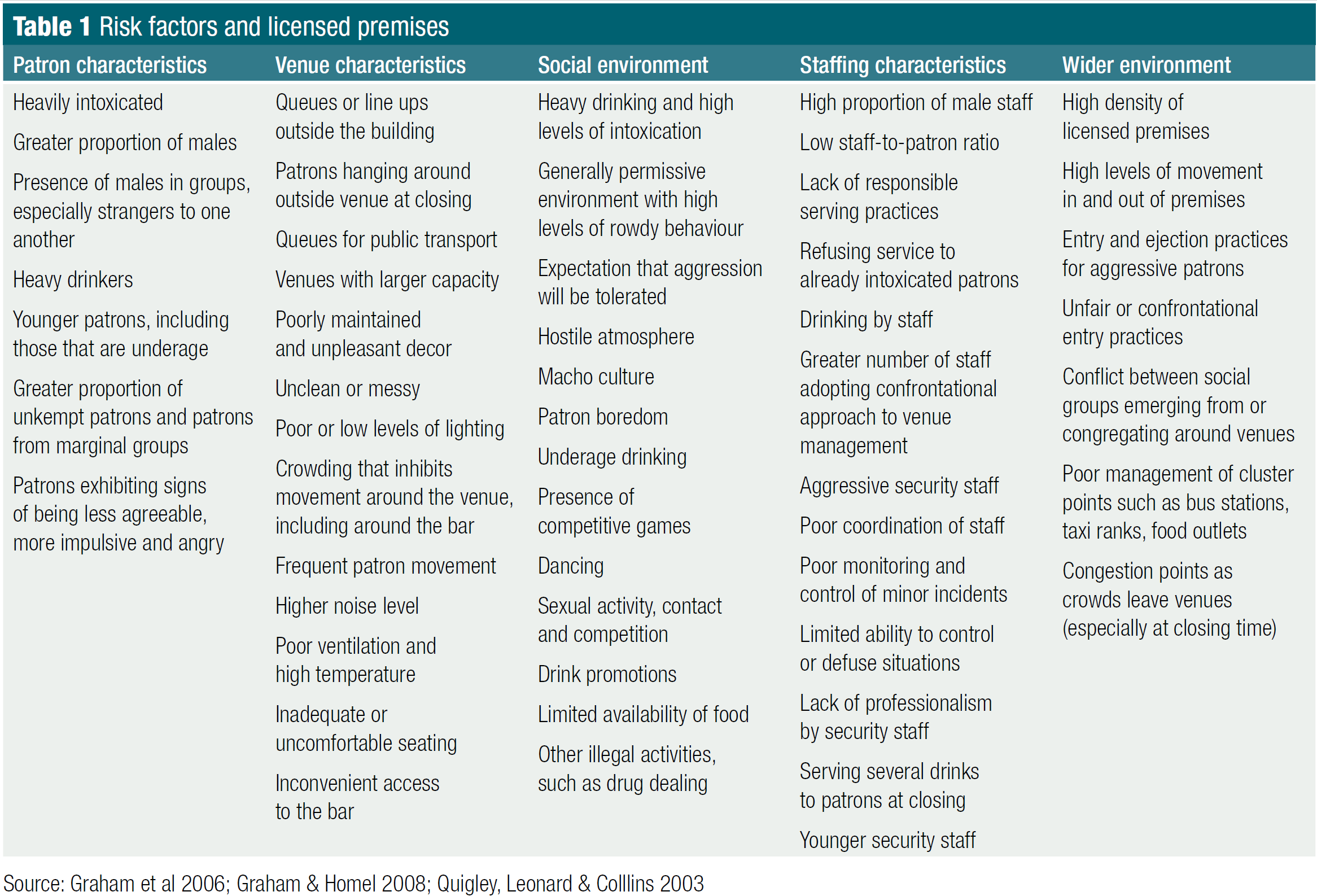
Table 1 above is a list of risk factors related to licensed premises. So the solution seems unbelievably easy: address the risk factor one by one then be done with it. So why are we still seeing problems? This is because there is a conflict of interest here: the owner of a premise might want to reduce violence, however eliminating the risk factors is likely to reduce the level of business they get. We then need to rely on the government to impose strict policies and rigorous policing in order to ensure pubs and clubs are doing everything they can to mitigate the risk. If government regulates that staff should be at the door to check ID for age, then they should regulate to have staff inside and outside the venue to ensure all risk-mitigating practices are correctly implemented. Fines and other penalties should be in place to cover a wider range of rules.
Outdoor Locations
While a large number of alcohol-related assaults take place outdoor, the offender and victim do not typically drink outdoor. They usually drink somewhere indoor, come outside, then start making trouble. Combine this with the fact that when both the victim and offender have consumed alcohol, alcohol-related violence is more likely to be spontaneous or opportunistic and more likely to involve strangers (Finney 2004), we see an obvious solution: ensure patrons to pubs and clubs are sent home safely and immediately after they exit the venue. This then requires an abundant supply of taxis, and staff responsible for putting patrons into taxis. Public bus is not the best option here as patrons still have a distance to walk when they get off the bus. The key here is to have staff responsible for ensuring every intoxicated patron gets a taxi and patrons do not wander off the street.
Residential Locations
This is perhaps the most complex of all locations. To start with, we have dubious cause and effect here: does alcohol cause domestic violence, or do violent people tend to drink more, as they are violent in the first place and alcohol is just an excuse? No clear evidence has been given to answer this question, nevertheless we shall make our best attempt to reduce domestic violence related to alcohol. Government policies are almost impossible to physically affect individual homes, and effective education to such a large mass of people scattered around enormous geographic area is impractical. The only hope here is early prevention. Government needs to ensure ready access and provision of healthcare intervention and treatment to people with alcohol or drug problems and people with tendency of violence. When someone reports that one of their family members needs help, healthcare professional must intervene. To this cause, government is required to ensure people know who to call and what services and benefits are provided, hence mass advertisement is required.
Time
On Friday and Saturday nights, ‘nearly three in four assault offenders had been drinking alcohol in the 48 hours prior to their arrest’ (Sweeney & Payne 2011). The benefit of targeting this specific time period is clear. The points raised above for licensed premises and outdoor locations must be reinforced during these times. More police officers should be sent patrolling areas with a high density of pubs and clubs. If they see anyone intoxicated, they should send those people home with taxis. If they see unusual activity at a pub or club, for example if the venue is overcrowded, steps need to be taken with the help of venue manager.
Correct Policing
When police do arrest offenders for assault, it is not enough to just give fine and/or jail time. A better preventative measure needs to be added: mandatory regular counselling. What stops an offender to commit a crime again should not be fear, we should instil in them a genuine despite for wrongdoing. We should force assault offenders to attend regular counselling sessions, until they are examined to be fit again.
Final Words
Finding where the problem is, and formulating solutions specifically tailored to these areas is what this paper attempts to achieve. However, as more data is revealed and more studies are done, it is possible that new solutions will be found. But the emphasis should be on execution, not idea. If we can successfully execute the ideas presented in this paper, we are sure to see improvement. And if this happens, we will see invaluable benefit for the alcohol industry as we gain a fresh image. Alcohol companies should be the leader at the forefront of this battle, making alcohol good for the society.
Reference
Preventative Health Taskforce 2009, Preventing alcohol related harm in Australia: a window of opportunity; Australia: the healthiest country 2020, Canberra: Australia Government.
Greenfield LA & Hennebery MA 2001, ‘Victim and Offender Self-Reports of Alcohol Involvement in Crime’, Vol 25, No. 1.
Teece M & Williams P 2000, Alcohol-related assault: time and place, Trends & issues in crime and criminal justice, No. 169, Canberra: Australian Institute of Criminology.
Sweeney J & Payne J 2011, Alcohol and assault on Friday and Saturday nights: Findings from the DUMA program, Research in Practice No. 14, Canberra: Australian Institute of Criminology.
Bryant M & Williams 2000, Alcohol and other drug-related violence and non-reporting, Trends & issues in crime and criminal justice, No. 171, Canberra: Australian Institute of Criminology.
Doherty SJ & Roche AM 2003, Alcohol and licensed premises: best practice in policing. A monograph for police and policy makers, Adelaide: Australasian Centre for Policing Research.
Briscoe S & Donnelly N 2001, Temporal and regional aspects of alcohol-related violence and disorder, Alcohol studies bulletin, No. 1.
Mcllwain G & Homel R 2009, Sustaining a deduction of alcohol-related harms in the licensed environment: a practical experiment to generate new evidence, Brisbane: Key Centre for Ethics, Law, Justice & Governance, Griffith University.
Finney A 2004, Violence in the night-time economy: key findings from the research, Home Office findings, No. 214, London: Home Office.


