Introduction
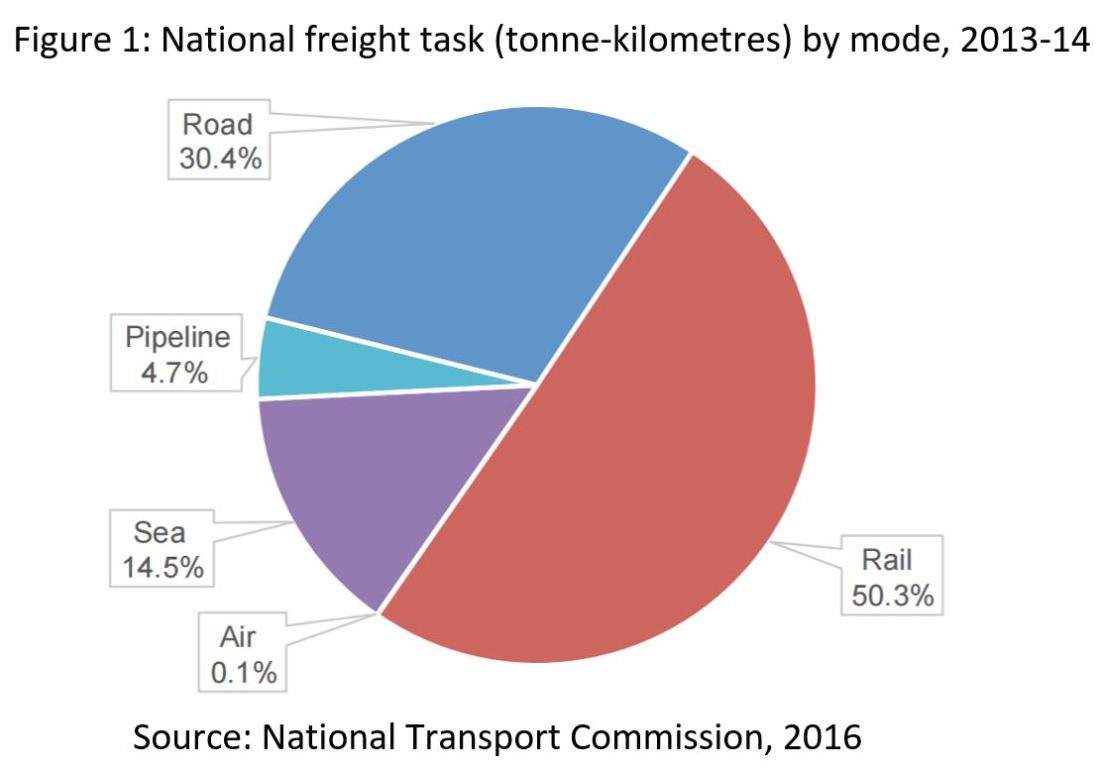
This paper endeavours to explore emerging future trends in the Australian trucking industry. Trucks are an integral part of the freight transportation and logistics sector in Australia which account for 30.4% of all national freight task (tonne-kilometres) in 2013-14 (Figure 1).
As such, trucks can be said to be the backbone of the Australian economy as almost all commercial activities heavily depend on logistics, or put naively, the movement of goods. How the trucking industry will evolve concerns not only truck operators, but also manufacturers, wholesalers, retailers, government and more.
Like almost all industries, trucking is inevitably being disrupted by digital technology. Things like driverless truck will understandably cause some discomfort, but it is a force we cannot stop, hence we need to start thinking about how to work with it now. Other less disruptive technologies such as fleet management software and the so called ‘Uber for trucking’ will see more embrace, enhancing the performance of fleet operators and giving them easier access to business opportunities.
As powerful as it is, technology may not be the most significant driver of the success (or otherwise) of trucking. The survival of trucking depends on freight on the market needing to be moved, and this is in turn associated with the commercial activities, or more generally, the economy of Australia. With stronger economy comes greater commercial activities, hence more freight movements, hence more demand for truck transportation. This means government policies have a profound impact on the prosperity of trucking. We also need to pay attention to the private sector. For instance, the entry of international e-commerce giants such as Amazon into Australia will boost the extent of commercial activities, a welcoming sign for the trucking industry.
In this article, trends will be presented in the order of occurrence, that is, the first one presented is most likely to be the first prediction to come into reality (or is already happening), and so on. We will look at how to maximize benefits from positive impacts and minimize losses from negative impacts. We will end by providing concrete action plans for truck operators.
Government Trade Deals
The Australian government has always been pro-trade. Australia has many Free Trade Agreements with other world powers such as China, Japan, Korea and the United States. One of the most significant in recent times is the China-Australia Free Trade Agreement which came into force on 20 December 2015. China was Australia’s largest trade partner even before this agreement, with China buying $85.9 billion of Australian exports in 2015-16, more than a quarter of Australia’s total exports to the world (Department of Foreign Affairs and Trade, 2017). The Agreement will further strengthen the mutual benefits, helping Australian goods exporters, Australian services providers, investors from both countries, Australian consumers, tourism and skilled worker mobility, and we will see more and cheaper imports from China. The increased level of imports and exports will directly benefit trucking as we now have more freight to be transported, and the broader implications of the Agreement will result in stronger economy growth, again an advantage for the trucking industry. It needs to be noted that the potential of the Agreement has not been fully realised yet. Tariffs are gradually being removed until 2026 and implementations are underway. This means we can expect continued growth in trucking industry. The exact amount of growth is not calculated here because it is outside the scope of this article.
Technology to Help with Fleet Management
At an age of technology today, many truck operators are still not reaping the power of technology and much of their work is paper-based. Dispatching and routing software is becoming more readily available to calculate trip time, most efficient route, task schedule to reduce truck idle time, and how to load a truck fully (placement of goods on the truck). A lack of data is also prevalent in the trucking business, with few operators collecting data on their trips. This problem is difficult to address since incentive for truck operators to collect data is weak. But the dawn of driverless trucks should provide a solution as data collection is a necessity for driverless trucks to become safer and smarter, more on this later.
Truck operators, especially those with large fleets, should start to adopt technology solutions for their operations in order to minimise cost and maximise return on investment. Technology will give operators competitive advantage in a fragmented market.
Growth of E-Commerce in Australia
A wave of fear is spread across the Australian retail space by the entry of Amazon, the American e-commerce giant, into Australia in 2018. By itself, Amazon is set to bring vast amount of commercial activities into Australia by attracting new shoppers and vendors both in Australia and abroad. More goods will be transported by road as sales transactions are made both domestically and internationally. Moreover, out of the fear of competition from Amazon, traditional retailers will be looking to enhance their online presence, reinforcing their own online sales channel. All of these combine to create great opportunities for trucking.
It must be noted the rise of e-commerce in Australia is a general trend, not due solely to Amazon. Another e-commerce superpower comparable to Amazon, Alibaba Group from China, has already opened their Australia and New Zealand headquarter in Melbourne in February 2017. E-commerce in Australia has much potential to be explored, and though physical retail stores may suffer, truck operators will become the winner.
Uber for Trucks
Uber is causing huge damage to their incumbent, taxi; but Uber’s newest venture, Uber Freight, may just help the incumbent that is the trucking companies. Uber Freight is a mobile app made by Uber which helps truck drivers to find freight work and vice versa. It is literally the Uber for trucks. Goods shippers can post jobs on the app, and truck drivers can browse and accept jobs. There are many other similar apps as well which give truck drivers even more options.
The effect of this new way of finding jobs is ambiguous. Firstly, we are just beginning to see apps like this and their businesses are still very small, at least we have not seen much traction in Australia. However, we can safely predict that it is a matter of time that this type of apps enters Australia and changes the way trucking companies operate. Secondly, one may argue this makes it easier for truck drivers to find job, but one may also argue this may decrease the price of freight transport due to more fierce competition. Already we are seeing many Uber drivers complain about the inadequacy of driver fees. Nonetheless, I believe the app presents more benefit than cost and we should adopt an optimistic attitude. In the end, it is just a market place facilitator for business transactions between shippers and truck drivers, and it should make life easier for all stakeholders.
Autonomous (Driverless) Trucks
This is the most interesting topic which is pursued by every large technology company and motor vehicle manufacturer (for example, Otto of Uber). The technology is here, autonomous trucks are safer, quicker and cheaper to run. Safer because they never get tired, can ‘see’ broader angles than human eye, and reaction time is shorter. Quicker because there will be no traffic congestion and the in-built GPS is constantly calculating best route and making changes if necessary. Cheaper to run because there is no driver, hence no wage. Due to government regulations and laws, we are not seeing much of this in Australia now, but it will happen sooner or later.
Sure, this may be the greatest thing that can happen to a fleet owner, but not for drivers. Autonomous trucks will render driving job obsolete. The problem is we do not really have a solution for this. But maybe there is no need for solution, there is no need to prevent this from taking place. Maybe this is a necessary step in the evolution of human society that we cannot, and should not, stop. Just like all other professions, most of our jobs are being threatened by machines, and the best solution we can think of so far is Universal Basic Income which is outside the scope of this article. For truck drivers today, they do not have to worry too much as it will be some time before government allows it and devises a plan for smooth transition. However, for truck drivers of the future, maybe now is the time to acquire new skills before it is too late.
What is to be done?
For truck operators, the main takeaways are as follow:
- Trade deals: target industries that will benefit the most from trade deals. These include but are not limited to: agriculture (such as wine and beef), natural resources, mining, pharmaceutical, electronics and white goods. Tariffs for these goods will be heavily reduced or eliminated (both export and import) hence we expect a lot more of these freights going in and out of Australia.
- Fleet management technology: embrace and adopt technology. Use technology to reduce cost and maximize productivity. It is difficult to differentiate oneself in the trucking business but technology is a good way to achieve this.
- E-commerce: target post and delivery companies. Try and obtain contractor work from them. Post and delivery companies are expected to get more business because of the rise of e-commerce activities, and truck operators can capture this growth by offering contractor work.
- Uber for trucks: when apps like Uber Freight arrive in Australia, try it out! If it works, then perfect. If it does not work, then abandon it. There is no harm in trying.
- Autonomous trucks: be patient, and wait for this to happen. Drivers should prepare themselves for this by acquiring new skills, and fleet owners should not be afraid to bring in autonomous trucks.
Reference
National Transport Commission. (2016). Who Moves What Where – Freight and Passenger Transport in Australia. Retrieved from http://library.unimelb.edu.au/recite/apa/report#type
Department of Foreign Affairs and Trade. (2017). China-Australia Free Trade Agreement Outcomes at a glance. Retrieved from http://dfat.gov.au/trade/agreements/chafta/fact-sheets/Pages/key-outcomes.aspx


