Schooling has become counter-intuitive. Everyone seems to agree that each student has unique interests, needs, and learning style, yet the ‘system’ puts them into age-defined year levels and classes and prescribe them the same curriculum. In any lesson, the teacher gives the same instruction to dozens of students, but the chances of that instruction being suitable to all students are quite low. As such, people have been advocating for highly individualised teaching and learning, with no progress to show for. Schools appear to be, by their nature, a construct of categorisation that imposes arbitrarily defined groups onto young people, because it is ‘efficient’. It is time for change.
Project-based Learning
There is a movement of project-based learning around the world. Many schools are embracing this approach, with unequal degrees of success. A prime example is High Tech High in California, USA. Their projects range from making a rocket, producing a book on influential leaders, researching watersheds, and many more. Projects can be months long with clear deliverables, learning intentions, and are usually concluded with a public expo.
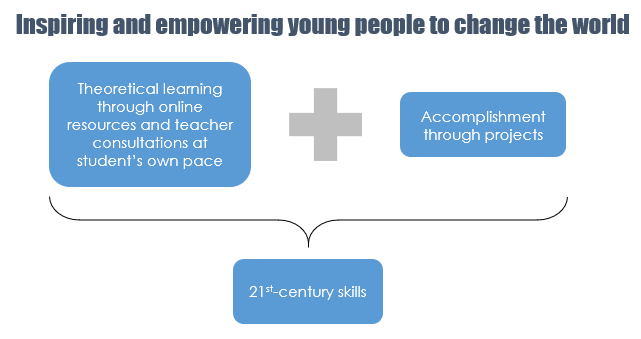
The idea of project-based learning ties closely with the idea of accomplishment advocated by Marc Prensky. The thing with which students should leave school is accomplishment. This can come in many forms: it could be a high grade, or a rocket prototype. What matters is that students should earn a sense of achievement. Capabilities are built via this process, and capabilities are what the modern workplace needs. The likely result of attaining accomplishment through projects is a combination of team spirit, inspiration, motivation, engagement, critical thinking, problem-solving skills, curiosity, creativity, and innovation.
Where is The Teaching?
It is clear that my vision for the utopia school involves student projects as the visible product, not grades or university entries. However, something is missing, for one could not build or produce something of value without the underlying knowledge. For instance, one cannot build a rocket without knowing how to calculate the amount of fuel needed. A prerequisite of project-based learning is theoretical learning. The basic textbook knowledge of theories, concepts, and skills is indispensable. The question is, how to teach it?
The quality of teaching is disparate among teachers. This means a student is at an advantage if they happen to have a good teacher, and vice versa. However, with the advent of digital technology, almost everyone has access to the highest quality instruction and assessments at their fingertips. Khan Academy is an example. Why don’t we get all our students onto these online resources, so that they can all receive the same high standard of content, instead of relying on luck to get a good teacher? In this case, explicit classroom teaching is altogether eliminated from a teacher’s duties. The teacher will synthesise useful online resources, plan the sequence of resources, and give them to students as a suggestion. Students have no timetable; they learn from and work on the online resources at their own pace, planning their everyday at school. The online resources should contain assessments and reporting for teachers to view. Teachers hold consultations where students drop in to ask questions and seek help. The school provides space for quiet study, group study, and consultations.
There will be no year levels or classes. A student might be working on Maths content equivalent to Year 8 level and English content equivalent to Year 9 level concurrently. They have the freedom to discover and utilise any resources, online and offline, and plan their time according to needs. This way, learning becomes highly personalised and unique to each individual. Students can pick what works best for them, instead of being forcibly fed the one-size-fit-all conventional teaching.
Co-curriculum
Apart from the usual co-curricular activities such as house competitions, music, performing arts, sports, and clubs, the utopia school focuses on the skills and traits that prepare students to change the world. Leadership, public speaking, critical thinking, financial literacy, digital literacy, entrepreneurship, and communication are just some examples. Business case competitions, public speaking competitions, startup pitch competitions, can all be held. External speakers from various industries are invited to speak at the school about their career journeys so that students are exposed to the many kinds of jobs out there and they can appreciate the abundance of opportunities.
Final Words
The utopia school’s mission is to inspire and empower young people to change the world. With its innovative student-led learning, real-life projects, and twenty-first-century skills training, the hope is to revolutionise education by spreading its methodology. The only way to measure its success is by looking at the degree at which its alumni have changed the world. This will take decades to materialise, but it sure is worth the wait.
tl;dr