Few high achievers become teachers in Australia. A 2019 study conducted by Grattan Institute paints a bleak picture. (Note: ATAR, which stands for Australian Tertiary Admission Rank, is the undergraduate degree entry score for secondary school students; an ATAR of 80 means your score is better than 80% of the students in your state)
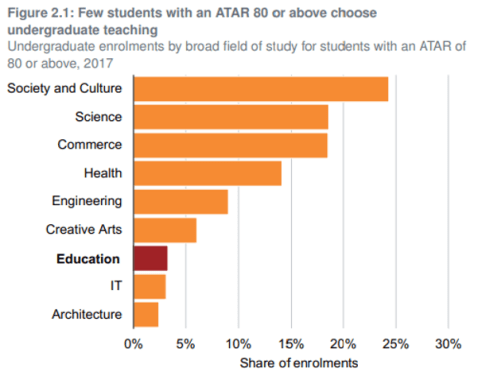
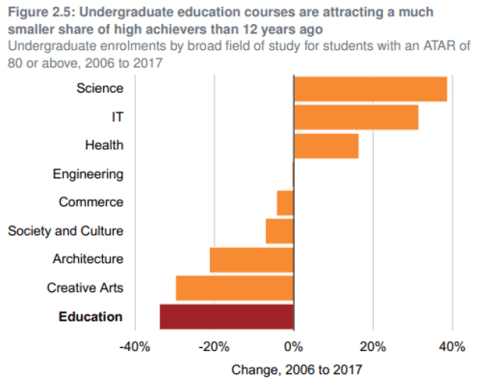
In addition to the two figures above, the median undergraduate entry score for Education is the lowest among all broad fields of study (ATAR 74, and you can lack a lot of the knowledge and skills prescribed by the school curriculum and still achieve this score). The higher your entry score, the less likely you will choose education. If nothing is done, Australia will be left with teachers who do not possess adequate content knowledge in their subject matters, a recipe for disaster.
Buy Why?
Why are high achievers staying away from teaching? A study conducted by researchers at the University of Melbourne offers some insights. In focus groups, school students submitted the following reasons:
- A teaching job is too demanding – long and after hours of correcting and planning plus difficult students;
- Not enough reward for the hard work – low pay and lack of prospects (no career progression);
- Low social status – teaching is negatively perceived in the community and teachers are not seen as “professionals”.
A teacher’s job is indeed difficult. As a pre-service teacher, I have seen teachers who have so many classes that they don’t have time to plan any lesson, teachers taking tests home to mark and working past midnight, and teachers who are bullied into crying by students.
Teachers’ salaries are not helping either. Here are some graphs from the Grattan report.
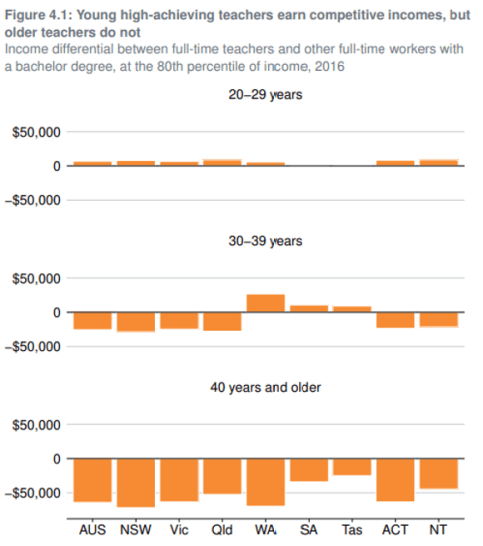
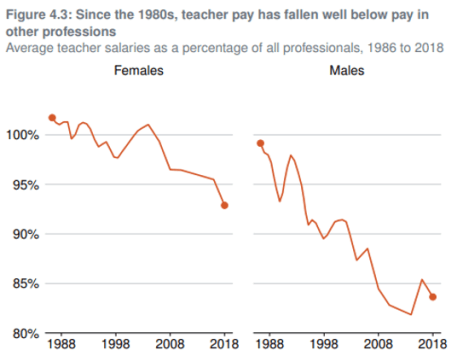
As we can see, both the current state and the trend are not doing teachers any favour. The starting salary of a fresh graduate may be higher for teachers, but as people progress further into their career, teachers lose out.
One of the reasons that teaching is not seen as a prestigious career may be the ease with which one can become teacher in Australia. Here is another figure from Grattan Institute.
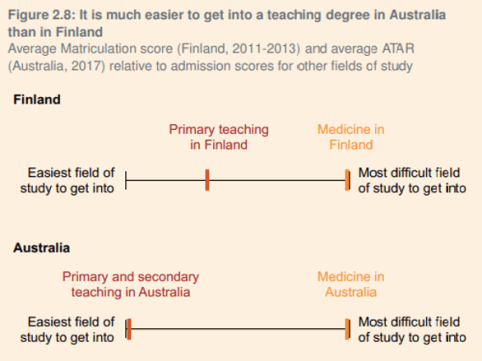
Teaching is the easiest degree to get into in Australia, and this sends all the wrong signal. As a student in an initial teacher education program, I have seen peers, as well as practising teachers, who do not know their subject content. If it is so easy to get into a job and those people are not good at their job, why would any society value those workers?
The Solution
Now that we know where the problems lie, we are ready to solve them.
The reason teaching is tougher than it needs to be is that schools are trying to hire as few teachers as possible to educate as many students as possible. This does not work. It makes economic sense but makes no educational sense. As a public good and human right, running a school should not take financial priority; it should take the educational outcomes of students as a priority. Thus, one simple way to alleviate workload is for schools to hire more teachers. There should be a more sensible maximum teaching hour limit. For instance, as OECD reports, Singaporean and Australian teachers spend the same amount of time planning lessons (7.2 and 7.3 hours per week respectively), but Singaporean teachers spend 17.9 hours teaching whereas their Australian counterparts spend 19.9 hours. Reducing the maximum number of hours a teacher is allowed to teach and hiring more teachers when student number increases will go a long way to improve teachers’ lives.
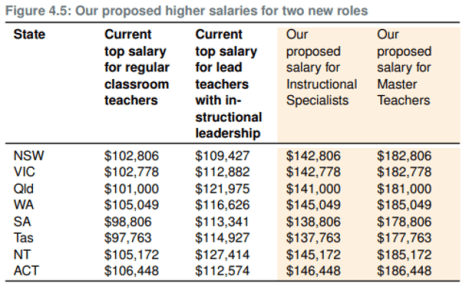
Grattan Institute’s proposal to introduce two additional teacher roles accompanied with substantial pay increase will provide both a career pathway and the salary required to justify the sacrifice teachers make. The proposal is summarised in the figure below.
To address the social status issue, the bar should be set higher for entry into initial teacher education programs (most are degrees offered by universities). For example, teachers in Finland are required to hold at least one Masters’ degree, only one in ten applicants of teacher training programs are accepted, and the process of program recruitment is extremely rigorous. Australia should model some of the best practices other countries are doing, and a good first step is to set a high entry score for education courses offered by universities. After all, shouldn’t content knowledge be the most basic requirement of a teacher?
Education is the backbone of a society. The future prosperity of a country is underpinned by it. The answers are all in front of us, but do we have the will to take them on?
tl;dr
- Schools need to stop trying to squeeze every bit out of every teacher; a reduced maximum hour of teaching should be set (perhaps as a government intervention), and more teachers should be hired if student numbers are increasing.
- Two additional lead teacher roles should be established with substantially higher remunerations.
- Set higher academic requirements for entry into teacher education programs to ensure those who don’t know the subjects they wish to teach are not allowed into teaching.


