Introduction
This paper endeavours to anticipate and explore future trends in the beer industry and opportunities on which breweries should focus in order to thrive. The list is by no means exhaustive and more work needs to be done. The key to business success is not good ideas, many people can have good ideas; instead the key is execution, the ability to bring good ideas into reality. The issues discussed in this paper are no secret to the industry, but the company that can successfully fulfil them will stand to the ultimate victory.
A New Marketing Tool – Brewery Tours
Wineries have long been doing this, open their wineries for visits and tours by general public. And they are having great success, this is in fact a major revenue source for many wineries, and it has become one of the most popular tourist attractions in Australia. If wineries can do it, so can breweries. Here are some benefits:
- This is an innovative method of marketing. If we give visitors a memorable experience, they are more likely to buy our beer in their future purchases. The key is to leave a lasting impression, make them admire our brewing process, our rigorousness, craftsmanship and passion. We align one group of customers at a time, and through word-of-mouth and our continuous effort, this will have tremendous marketing effect. It will also create a more friendly brand image which will help in the competition with craft beer.
- On-site sales. After a free guided tour into the production and brewing of beer, visitors are invited to taste different kinds and flavours of beer, with simple appetizers that complement particularly well with our beer. This will result in beer purchase at the end of the tour. This sale may seem small when compared to sales through retailers and pubs, but if we scale up and do this all around the world, it becomes substantial.
- Host special events. We can use our brewery to host special events such as wedding and company function. This will come with a fee of course, and again is an excellent marketing tool. Point 1 above allows us to get close to our customers, but visitors to general tours are self-selected, meaning they are already interested in our beer before they come. Special events then enables us to introduce our beer to people who are not already our customers or beer-drinkers as their attendance does not depend on their beer preference.
Brewery tours open up a whole range of possibilities. It is the best way for us to engage with customers and customer engagement is our biggest challenge when faced with competition from craft beer.
Craft Beer
Any talk of the future of beer cannot ignore craft beer. It is well known in the industry that craft beer is taking over the market and is a major (if not only) area of growth. It is changing consumer preference, the competitive landscape, and everything in between.
Brewers Association, a major craft brewers trade association in USA, defines craft brewer using the following three points1:
- Small: annual production of 6 million barrels of beer or less.
- Independent: less than 25% of the craft brewery is owned or controlled by an alcohol industry member that is not itself a craft brewer.
- Beer flavour is derived from traditional or innovative brewing ingredients and their fermentation.
This definition is of course debatable, and I personally do not 100 percent agree with the above, but it is a working definition. Based on this definition, we have some statistics from Brewers Association, shown below2.
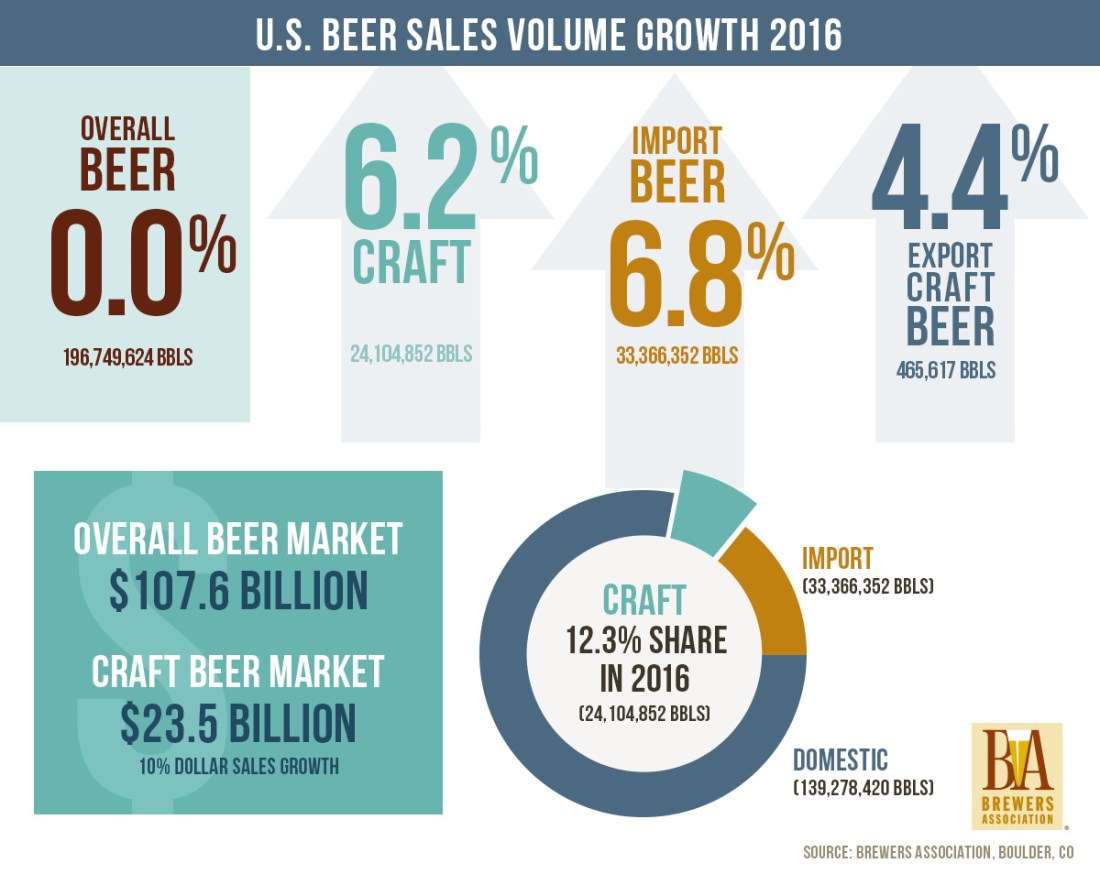
The Brewers Association was of course not unbiased when preparing these statistics as they represent and advocate for craft brewers. Due to my limitation on time and financial resources I was not able to find better statistics, but in general these numbers agree with other research done on the same topic.
Here are a few key points of observation:
- Whilst overall beer sales by volume in 2016 did not grow at all, craft beer grew by 6.2%. This shows that craft beer is at least a major area of growth in the beer market, and non-craft beer may be gradually losing its market share to craft beer.
- In 2016, craft beer constituted 21.8% of the overall beer market by sales dollar, and this is after a 10% sales dollar growth in craft beer. Compare this to the volume share of craft beer which is 12.3%, we see that the dollar share of craft beer is larger than its volume share. This means craft brewers are doing something right about their pricing, or their consumers’ price elasticity is low due to maybe loyalty. It thus follows that we have a lot to learn from craft brewers, as this achievement is difficult to come by.
In conclusion, we see that large international brewers need to take note of craft beer and start exploring this segment. Instead of trying to compete with craft beer head-on, large brewers should try to include craft beer as part of their business, that is, capture the growth instead of trying to reverse it. This is best done through acquisition, and we are already seeing a lot of this in recent years. It is also important that after the acquisition, all staff of the craft brewery are kept because as we saw in point 2 above, we have a lot to learn from them and they know their business the best.
All major players in the beer industry are acquiring craft brewers, for example AB InBev. Under the leadership of Andy Goeler, AB InBev has already acquired Goose Island, Blue Point, 10 Barrel and Elysian since 2011. Here aggressiveness should be applauded, since this is the most conceivable way to achieve growth. Moreover, this is the trend that all major breweries are following, so if anyone brewery does not move fast and decisively, they will lose.
It must be mentioned that AB InBev is really doing their acquisition right, retaining original staff of the craft brewers and maintaining a healthy relationship with the craft beer circle. There are reasons that craft beers are stealing market share from large international breweries, and it is crucial for large breweries to keep those reasons. Whether it be taste or sales channel, expertise from original craft beer company cannot be compromised, for we do not want to defeat the purpose of acquiring craft beer.
Final Words
Beer breweries can look to other similar industries and markets for inspiration such as the brewery tours inspired by winery tours. As sales growth is becoming increasingly difficult, we need to find new ways to promote our brands and products, searching beyond traditional means.
It is the glass-half-full-or-half-empty story again, craft beer can be viewed as a threat or an opportunity, depending on your perspective. I tend to see it as opportunity: if craft beer sales are growing, simply sell craft beer! Craft beer is the most foreseeable future of the beer industry, and we should all embrace it, sharing its success together.
Lastly, remember, execution is key, execution trumps idea, execution is everything.
Sources
- The definition of craft brewer: https://www.brewersassociation.org/statistics/craft-brewer-defined/
- Statistics from Brewers Association: https://www.brewersassociation.org/statistics/national-beer-sales-production-data/

 bigWU
bigWU 
Awesome
LikeLike